
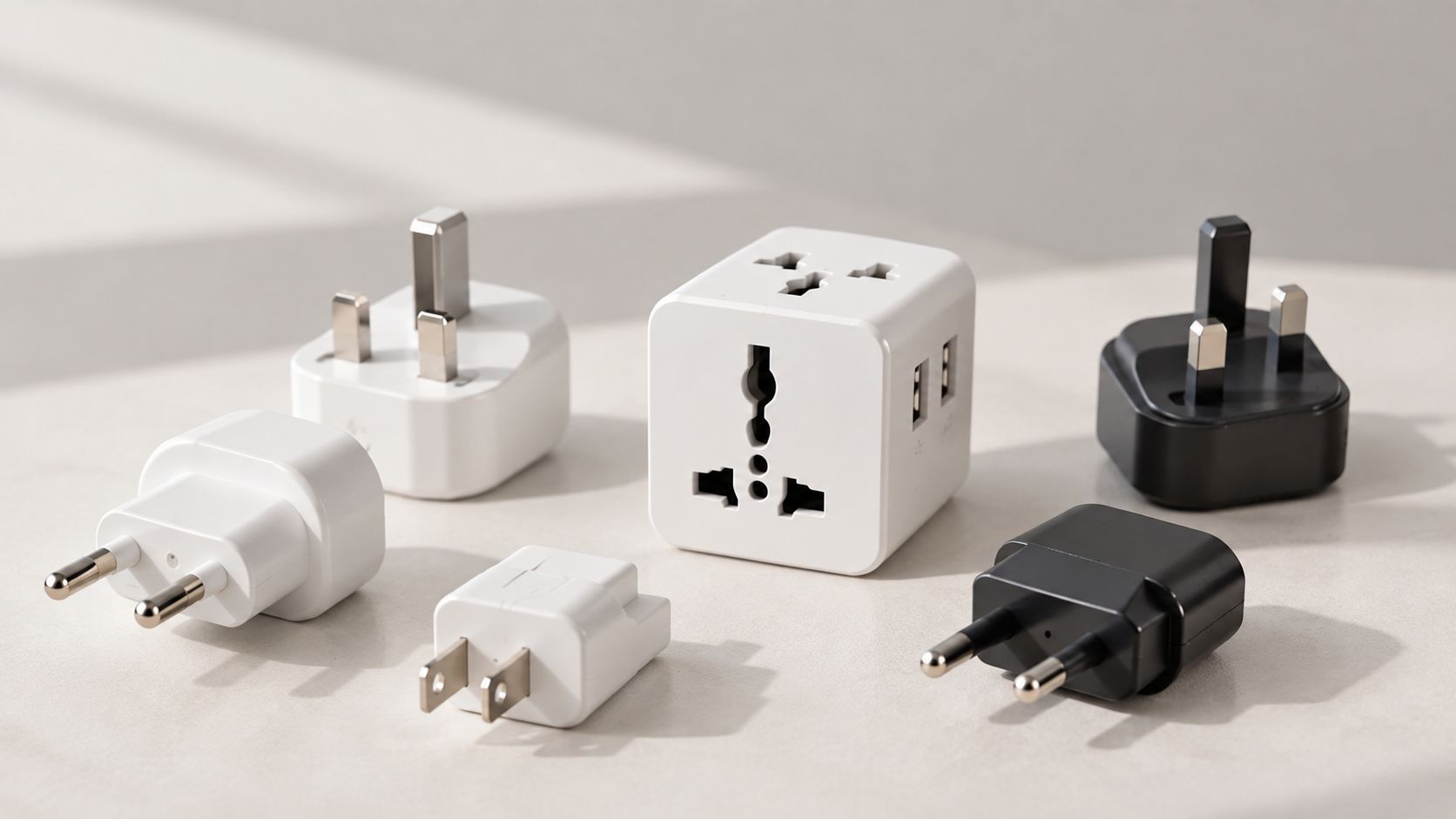
Planning a trip to Taiwan and wondering which travel adapter to bring—or what kind of clothes you should pack?
Taiwan mainly uses Type A and Type B power outlets, with a standard electricity supply of 110V at 60Hz. Travelers from the United States and Canada will find the plug shapes familiar, while visitors from the UK, Singapore, Australia and most European countries will normally need a travel adapter.
Weather requires a little more planning. Taiwan is warm and humid for much of the year, but conditions can vary considerably between Taipei, southern Taiwan and mountain destinations.
This guide covers the essentials you should know before departure: Taiwan plug types, voltage, travel adapters, electrical compatibility, seasonal weather and what to pack for Taiwan.
Taiwan’s Tourism Administration confirms that the standard electricity supply is 110V at 60Hz.
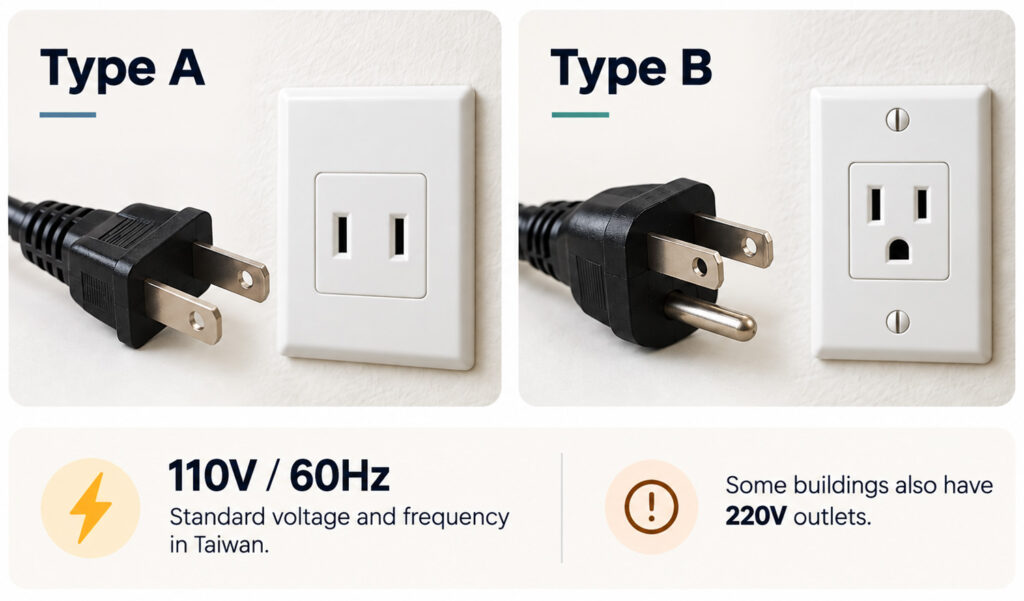
Table of Contents
🔌 Taiwan Plug Type & Voltage at a Glance
| Taiwan Travel Essential | What You Need to Know |
|---|---|
| Plug Type | Type A and Type B |
| Voltage | 110V |
| Frequency | 60Hz |
| US / Canada Adapter Needed? | Usually no |
| UK / Singapore Adapter Needed? | Yes |
| Europe Adapter Needed? | Yes |
| Australia / New Zealand Adapter Needed? | Yes |
| Japan Adapter Needed? | Usually no |
| Dual-voltage devices | Usually compatible if marked 100–240V |
| Weather | Varies by season, region and elevation |
The most important thing to remember is that plug shape and voltage are two different issues.
Even if your plug physically fits a Taiwan outlet, you should still check the voltage rating printed on your charger or appliance.
What Plug Type Does Taiwan Use?
Taiwan primarily uses Type A and Type B electrical outlets.
Type A Plug
A Type A plug has two flat parallel pins.
This is the same basic plug shape commonly used in the United States, Canada and Japan.
Type B Plug
A Type B plug has two flat parallel pins plus one round grounding pin.
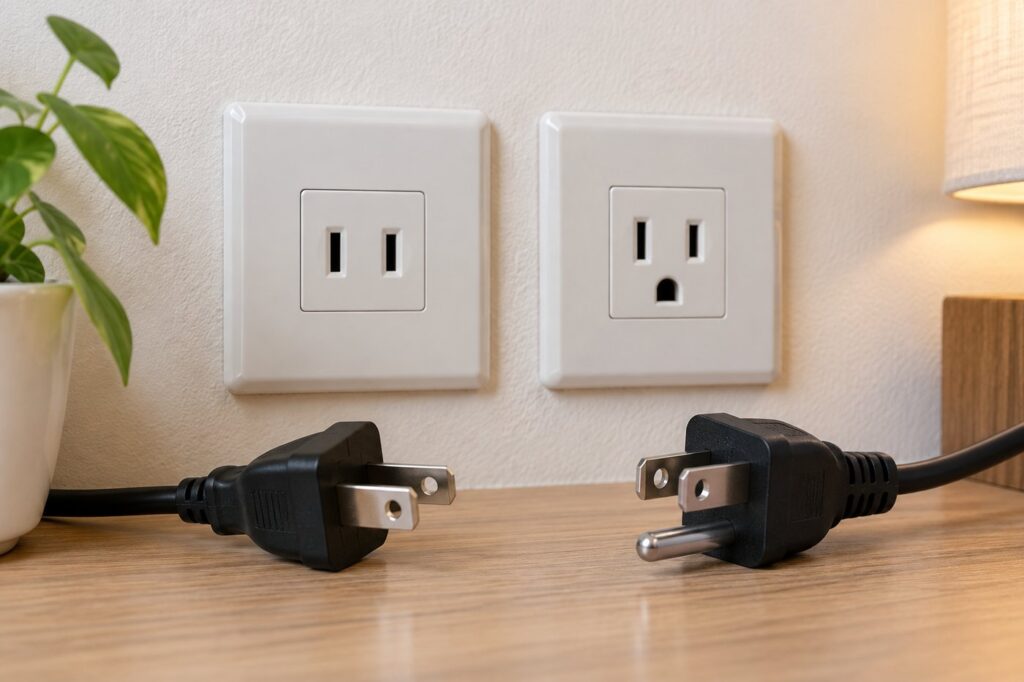
Type B outlets can normally accept both Type A and Type B plugs.
For travelers from the United States and Canada, this means that most phone chargers, laptop chargers and other everyday electronics will physically fit Taiwan’s outlets without a plug adapter.
However, you should still check your device’s voltage rating before use.
Do I Need a Travel Adapter for Taiwan?
It depends on which country your plug comes from.
If your device already uses a Type A or Type B plug, you will usually not need a plug adapter.
Travelers from the United States and Canada can generally plug their devices directly into Taiwan outlets.
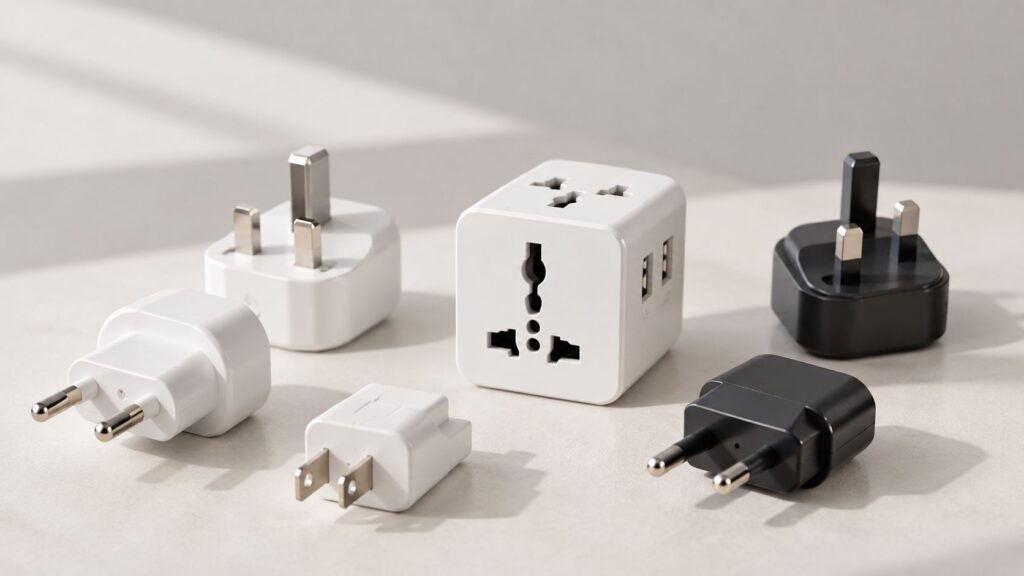
Travelers from the UK, Singapore, Malaysia, Australia, New Zealand and most European countries will normally need an adapter because their plugs have a different shape.
Travelers from countries that use several plug standards—such as China, Thailand, Vietnam or the Philippines—should check the actual plug attached to their device rather than relying only on the country of origin.
Taiwan Plug Adapter by Country
Here is a quick comparison for some of Taiwan’s most common international travel markets.
| Traveling From | Common Plug Type | Adapter for Taiwan? |
|---|---|---|
| United States | A / B | Usually no |
| Canada | A / B | Usually no |
| Japan | A / B | Usually no |
| Singapore | G | Yes |
| Malaysia | G | Yes |
| United Kingdom | G | Yes |
| Australia | I | Yes |
| New Zealand | I | Yes |
| France | C / E | Yes |
| Germany | C / F | Yes |
| Italy | C / F / L | Yes |
| Spain | C / F | Yes |
| South Korea | C / F | Yes |
| Hong Kong | G | Yes |
| China | A / I | Depends on your plug |
| Philippines | A / B / C | Depends on your plug |
| Thailand | A / B / C / O | Depends on your plug |
| Vietnam | A / B / C | Depends on your plug |
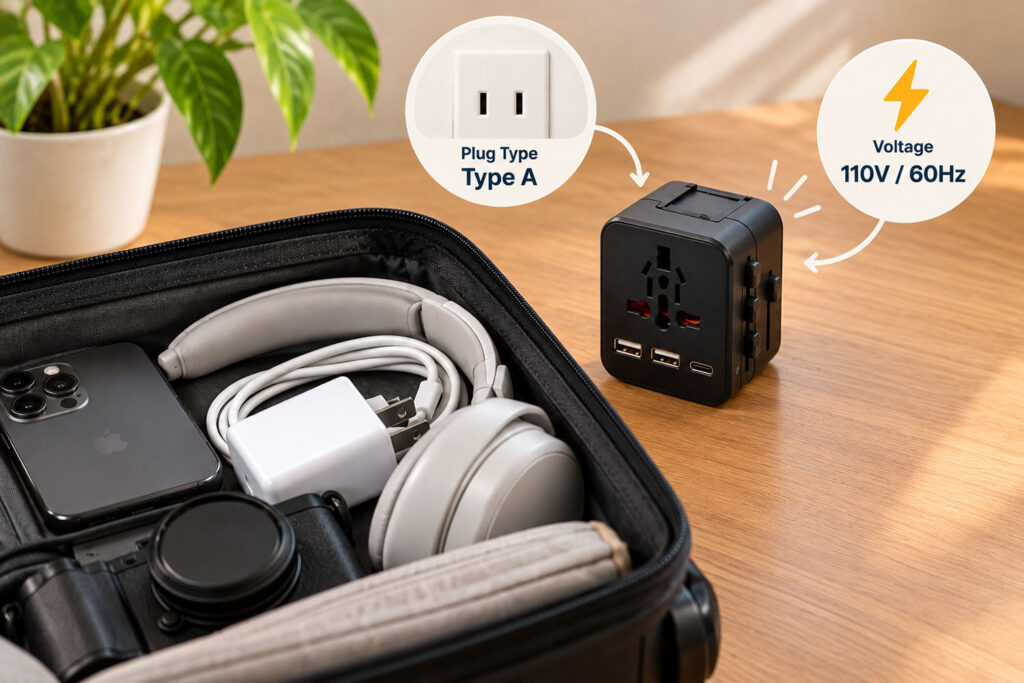
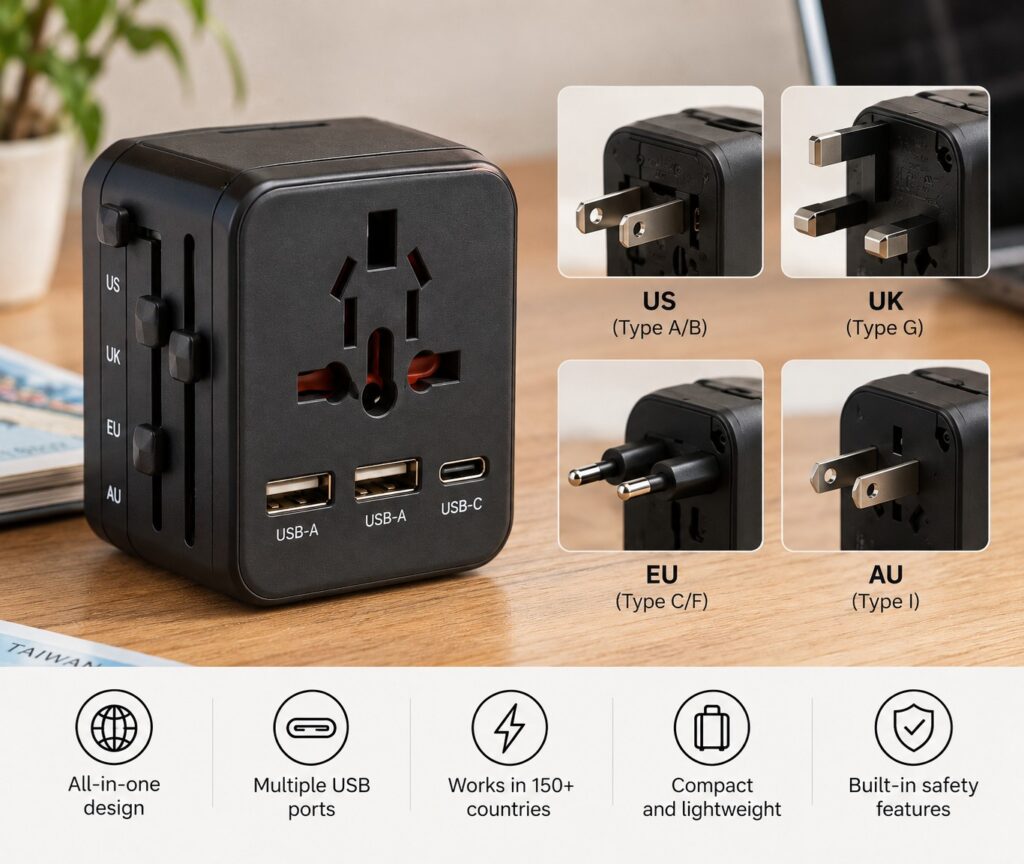
If you are visiting several Asian countries on the same trip, a universal travel adapter can be more convenient than carrying separate adapters.
Plug Types Around the World
There are many different electrical plug standards worldwide. The table below covers major countries and regions that travelers commonly combine with a trip to Taiwan.
Important: An adapter only changes the shape of your plug. It does not convert voltage.
| Country / Region | Common Plug Type | Voltage | Frequency | Adapter for Taiwan? |
|---|---|---|---|---|
| Taiwan | A / B | 110V | 60Hz | — |
| United States | A / B | 120V | 60Hz | Usually no |
| Canada | A / B | 120V | 60Hz | Usually no |
| Mexico | A / B | 127V | 60Hz | Usually no |
| Colombia | A / B | 110V | 60Hz | Usually no |
| Costa Rica | A / B | 120V | 60Hz | Usually no |
| Dominican Republic | A / B | 120V | 60Hz | Usually no |
| Japan | A / B | 100V | 50/60Hz | Usually no |
| China | A / I | 230V | 50Hz | Depends |
| Hong Kong | G | 230V | 50Hz | Yes |
| Macau | G | 230V | 50Hz | Yes |
| South Korea | C / F | 230V | 60Hz | Yes |
| Singapore | G | 230V | 50Hz | Yes |
| Malaysia | G | 230V | 50Hz | Yes |
| Indonesia | C / F | 230V | 50Hz | Yes |
| Thailand | A / B / C / O | 230V | 50Hz | Depends |
| Philippines | A / B / C | 230V | 60Hz | Depends |
| Vietnam | A / B / C | 230V | 50Hz | Depends |
| Cambodia | A / B / C / F / G | 230V | 50Hz | Depends |
| India | D / M | 230V | 50Hz | Yes |
| Australia | I | 230V | 50Hz | Yes |
| New Zealand | I | 230V | 50Hz | Yes |
| United Kingdom | G | 230V | 50Hz | Yes |
| Ireland | G | 230V | 50Hz | Yes |
| France | C / E | 230V | 50Hz | Yes |
| Germany | C / F | 230V | 50Hz | Yes |
| Italy | C / F / L | 230V | 50Hz | Yes |
| Spain | C / F | 230V | 50Hz | Yes |
| Portugal | C / F | 230V | 50Hz | Yes |
| Netherlands | C / F | 230V | 50Hz | Yes |
| Austria | C / F | 230V | 50Hz | Yes |
| Switzerland | C / J | 230V | 50Hz | Yes |
| Czech Republic | C / E | 230V | 50Hz | Yes |
| Poland | C / E | 230V | 50Hz | Yes |
| Greece | C / F | 230V | 50Hz | Yes |
| Sweden | C / F | 230V | 50Hz | Yes |
| Norway | C / F | 230V | 50Hz | Yes |
| Denmark | C / F / K | 230V | 50Hz | Yes |
| Turkey | C / F | 230V | 50Hz | Yes |
| Brazil | C / N | 127/220V | 60Hz | Yes |
| Argentina | I | 230V | 50Hz | Yes |
| Chile | C / L | 230V | 50Hz | Yes |
| United Arab Emirates | G | 230V | 50Hz | Yes |
| Saudi Arabia | G | 230V | 60Hz | Yes |
| Israel | C / H | 230V | 50Hz | Yes |
| South Africa | C / M / N | 230V | 50Hz | Yes |
Electrical standards can vary in countries using more than one outlet type, so travelers should always check the actual plug and voltage rating of their device. The country standards above follow the international country-by-country electricity reference maintained by World Standards.
Taiwan Voltage: Do You Need a Voltage Converter?
This is where travelers often get confused.
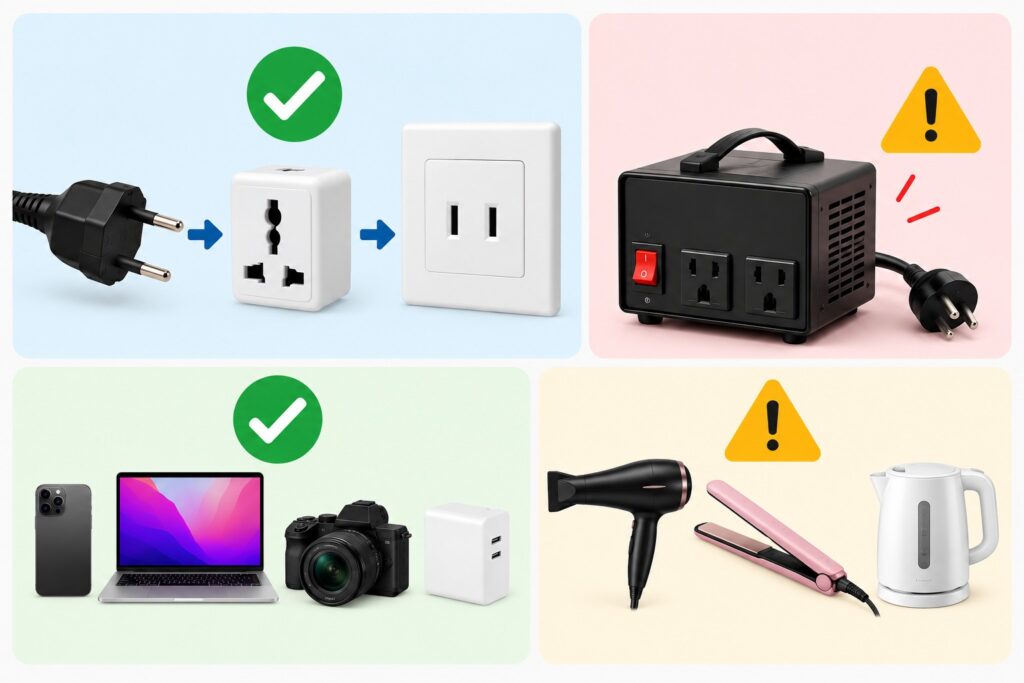
A plug adapter and a voltage converter do different jobs.
A plug adapter simply allows one plug shape to fit into another type of wall outlet.
A voltage converter changes the electrical voltage supplied to your device.
Taiwan uses 110V at 60Hz. (Taiwan Tourism Administration)
Before plugging in your device, look for the word INPUT on the charger or power supply.
If Your Device Says:
INPUT: 100–240V, 50/60Hz
Good news. This is a dual-voltage or multi-voltage device and can normally be used in Taiwan without a voltage converter.
You may still need a plug adapter if your plug is not Type A or Type B.
If Your Device Says:
INPUT: 110–120V
It is designed for a voltage range similar to Taiwan’s electricity supply. Check the manufacturer’s instructions, but a voltage converter is normally unnecessary.
If Your Device Says:
220–240V only
Be more careful.
A plug adapter alone will not change Taiwan’s 110V electricity into 220–240V. The appliance may not work correctly on Taiwan’s lower voltage.
This is particularly important for high-power appliances such as hair dryers, curling irons and other heating devices.
Can I Charge My Phone in Taiwan?
Usually, yes.
Most modern smartphone chargers are designed for international use and accept a broad voltage range such as:
100–240V, 50/60Hz
Check the small print on your charger before traveling.
If it shows 100–240V, you normally only need to consider whether the plug physically fits Taiwan’s Type A/B outlets.
For example, an American phone charger will usually plug directly into the wall, while a UK or Singapore charger will require an adapter.
Can I Use My Laptop or Camera Charger in Taiwan?
Most modern laptop, camera and USB chargers are also designed for international travel.
Look at the power adapter for something similar to:
INPUT: 100–240V ~ 50/60Hz
If you see this range, the charger should normally be compatible with Taiwan’s electricity supply.
You may still need a plug adapter depending on the plug used in your home country.
Can I Use a Hair Dryer or Hair Straightener in Taiwan?
Hair dryers and other high-power appliances deserve extra attention because they are more likely than phone chargers to be single-voltage.
If your appliance is marked only for 220–240V, it may not operate correctly on Taiwan’s 110V electricity supply.
Rather than carrying a heavy voltage converter, it is often easier to use a hair dryer supplied by your hotel or bring a dual-voltage travel appliance.
Always check the manufacturer’s specifications before use.
Where Can I Buy a Travel Adapter in Taiwan?
If you arrive in Taiwan without an adapter, don’t panic.
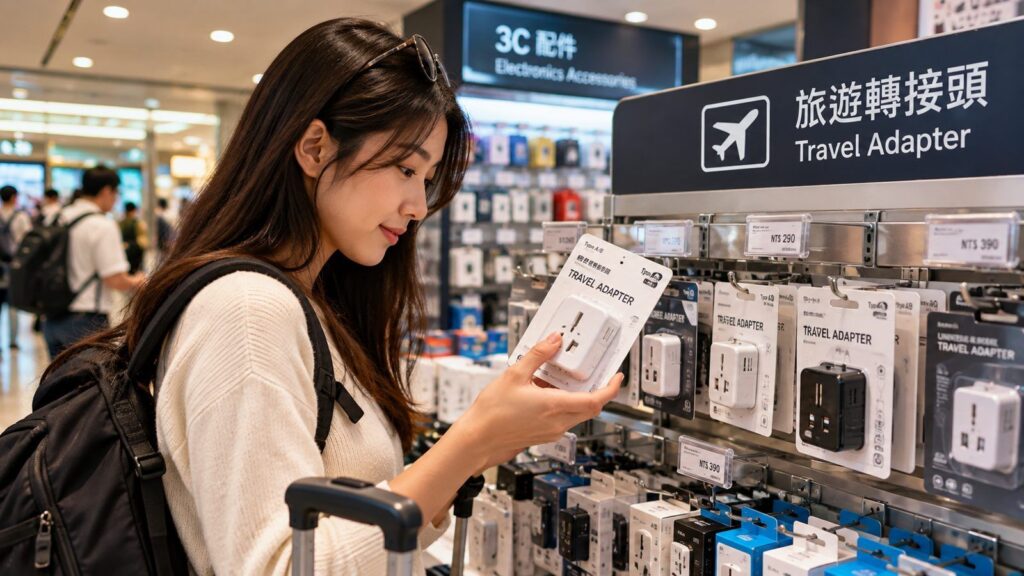
Travel adapters can usually be found at larger electronics retailers, department stores, travel-accessory shops and some airport shops. Basic adapters may also be available at selected convenience or general merchandise stores, although stock varies by location.
For example, a popular Taiwanese electronic department store in Taipei is Guang Hua Digital Plaza (光華商場)
If your trip begins in Taipei, finding a basic travel adapter is generally not difficult.
However, if you use a less common plug type or need a voltage converter rather than a simple adapter, it is better to purchase one before departure.
Taiwan Weather: What Should You Pack?
Once your electronics are sorted, the next question is what to pack for Taiwan’s weather.
Taiwan may be a relatively small island, but the weather can feel very different depending on season, location and elevation.
Taipei and northern Taiwan tend to be cooler and wetter in winter, while cities in southern Taiwan generally remain warmer. Mountain destinations can be significantly cooler than Taiwan’s cities at any time of year.
For a detailed month-by-month breakdown of temperatures, rain, typhoons and the best places to visit, read our Taiwan Weather by Month: Best 12-Month Travel Guide.

Taiwan Weather & What to Pack by Season
| Season | Typical Conditions | What to Pack |
|---|---|---|
| Spring: March–May | Mild to warm, increasingly humid, with periods of rain | T-shirts, light layers, comfortable shoes, umbrella or rain jacket |
| Summer: June–September | Hot and humid, frequent afternoon showers; typhoons are possible | Breathable clothing, sunscreen, umbrella, water bottle, light indoor layer |
| Autumn: October–November | Warm at first, gradually cooler and generally comfortable | Light clothing, comfortable walking shoes, thin jacket for evenings |
| Winter: December–February | Cooler and often damp in northern Taiwan; generally warmer in southern Taiwan | Long pants, sweater or jacket, additional layers for mountain trips |
These are general seasonal patterns rather than fixed rules. Taiwan’s actual weather can change quickly, especially during transitional seasons or when tropical weather systems are nearby. For more detailed packing advice by month, use our Taiwan weather guide.
Spring in Taiwan: March to May
Spring can be an excellent time for sightseeing, but travelers should be prepared for changing conditions.
March may still feel relatively cool in northern Taiwan, while temperatures gradually become warmer and more humid through April and May.
Rain becomes more frequent later in the season, so a compact umbrella or lightweight waterproof jacket is useful.
Dress in layers rather than packing only warm or only summer clothing.
Summer in Taiwan: June to September
Taiwan summers are hot, humid and sunny, with daytime temperatures frequently climbing above 30°C in the cities.
Lightweight, breathable clothing is the most comfortable choice.
Sun protection is also important, especially if your itinerary includes outdoor attractions, walking tours or cycling.
Short but heavy rain showers are common, so carrying a compact umbrella is useful even when the morning begins with blue skies.
Air conditioning can also be strong inside shopping malls, restaurants, trains and hotels, so a thin outer layer can still be useful.
Summer and early autumn are also Taiwan’s main typhoon period. Travelers should follow weather forecasts and be prepared for itinerary changes if severe weather affects transportation or attractions.
Autumn in Taiwan: October to November
Autumn is one of the easiest seasons to pack for.
October can still feel quite warm, especially in central and southern Taiwan, while November usually brings more comfortable temperatures.
For city sightseeing, light clothing is often enough during the day. A thin jacket or extra layer is useful for cooler evenings, rainy days and higher elevations.
Autumn is especially comfortable for travelers who want to combine cities with outdoor sightseeing without Taiwan’s strongest summer heat.
Winter in Taiwan: December to February
Winter in Taiwan is generally mild at lower elevations, but it does not feel the same everywhere.
Taipei and northern Taiwan can be cool, damp and windy, which often makes the temperature feel colder than the thermometer suggests.
Southern Taiwan is usually milder and can still be pleasantly warm during the daytime.
For Taipei, bring long pants, a sweater and a jacket. You may not need a heavy winter coat for normal city sightseeing, but travelers who feel the cold easily should bring an additional layer.
And remember: mountain weather is different from city weather.
Mountain Weather in Taiwan Is Different
If your Taiwan itinerary includes mountain destinations such as Alishan, do not pack based only on the weather forecast for Taipei.
Temperatures decrease significantly with elevation, and mornings and evenings can feel cold even when Taiwan’s cities are warm.
Bring additional layers, especially if you plan to wake early for a sunrise experience.
If Alishan is part of your itinerary, take a look at our Alishan 2-Day Private Tour from Taipei to see how a mountain stay can fit into a Taiwan trip.
Taiwan Packing Checklist
The combination of Taiwan’s electrical system and changing weather means a little preparation goes a long way.
| What to Pack | Why |
|---|---|
| Phone charger | Essential for navigation, photos and communication |
| Travel adapter | Required if your plug is not Type A/B |
| Power bank | Useful during long sightseeing days |
| USB-C / multi-port charger | Helpful when charging several devices |
| Comfortable walking shoes | Taiwan itineraries often include plenty of walking |
| Compact umbrella | Useful for both rain and strong sun |
| Lightweight rain jacket | Especially useful in spring and rainy periods |
| Breathable clothing | Important during Taiwan’s humid months |
| Sunscreen | Useful throughout much of the year |
| Light sweater or jacket | Air conditioning and cooler evenings |
| Warmer layers | Needed for mountain destinations |
| Reusable water bottle | Particularly useful in warm weather |
| Passport and travel documents | Keep important travel documents accessible |
The easiest way to pack for Taiwan is to think in layers. You may experience a warm afternoon, strong air conditioning and a cooler evening all on the same day.
Taiwan Plug Type & Weather FAQ
What plug type is used in Taiwan?
Taiwan mainly uses Type A and Type B plugs. Type A has two flat parallel pins, while Type B adds a round grounding pin.
What voltage does Taiwan use?
Taiwan’s standard electricity supply is 110V at 60Hz. (Taiwan Tourism Administration)
Do Americans need a plug adapter in Taiwan?
Usually not. The United States and Taiwan both commonly use Type A and Type B plugs. However, travelers should still check the voltage rating of individual appliances.
Do Canadians need an adapter for Taiwan?
Usually not. Canadian Type A and Type B plugs normally fit Taiwan’s electrical outlets.
Do travelers from Singapore need an adapter in Taiwan?
Yes. Singapore mainly uses Type G, so travelers should bring a Type G-to-Type A/B travel adapter.
Do UK travelers need an adapter in Taiwan?
Yes. The UK uses Type G plugs, which do not fit standard Taiwan Type A/B outlets without an adapter.
Do Australians need a travel adapter for Taiwan?
Yes. Australia uses Type I plugs, so an adapter is required for standard Taiwan outlets.
Do Europeans need a plug adapter for Taiwan?
Usually yes. Most European countries use Type C, E or F plugs, which do not fit standard Taiwan Type A/B outlets.
Can I charge my iPhone in Taiwan?
Most modern phone chargers support 100–240V and can be used internationally. Check the voltage information printed on your charger. You may still need a plug adapter depending on where the charger was purchased.
Do I need a voltage converter in Taiwan?
Not necessarily. If your device says 100–240V, 50/60Hz, you normally do not need a voltage converter. If it is designed only for 220–240V, check the manufacturer’s instructions before using it in Taiwan.
What should I wear in Taiwan?
It depends on the season and destination. Summer requires lightweight and breathable clothing, while winter travelers should bring warmer layers for Taipei and substantially warmer clothing for mountain destinations. For monthly temperatures and packing recommendations, see our complete Taiwan Weather by Month guide.
Does it snow in Taiwan?
Snow is possible at Taiwan’s highest elevations during strong winter cold spells, but it is not typical winter weather for most travelers. Taipei, Taichung, Tainan and Kaohsiung do not experience a normal snowy winter climate. For most visitors, Taiwan winter means cooler weather rather than snow.
✨ Planning Your Taiwan Trip?
Knowing which adapter to bring and what clothes to pack takes care of two of the most common pre-trip questions. The next step is deciding where to go.
If this is your first visit, browse our popular Taiwan private tours for ideas covering Taipei, northern Taiwan, Sun Moon Lake, Alishan and more.
Travelers with limited time can explore our Taiwan private one-day tours, while those who want to see more of the island can consider our Taiwan multi-day private tours.
For a longer trip connecting several of Taiwan’s most memorable destinations, our 5-Day Taiwan Private Tour with Jiufen, Sun Moon Lake and Alishan combines cities, mountain towns, lakes and high-mountain scenery in one private itinerary.
With a little preparation—and the right adapter—you’ll be ready to enjoy Taiwan without worrying about whether your phone will charge or whether you packed for the wrong weather.