

Ask a first-time visitor what Taiwan is famous for drinking and there is a good chance the answer will be:
Fair enough. Taiwan did give the world one of its most successful drinks.
But travel outside Taipei—or simply sit down in a traditional tea house—and you discover that Taiwan’s relationship with tea goes much deeper than pearls and milk.
There is floral high-mountain oolong grown above the clouds in Alishan. Roasted Tieguanyin in the hills of Maokong. Honey-scented Oriental Beauty from Hsinchu and Miaoli. Traditional Dong Ding from Nantou. Ruby Red black tea beside Sun Moon Lake. And a surprisingly modern Red Oolong developed in Taitung.
The confusing part is knowing what all those names actually mean.
Is Alishan a kind of tea?
Is Jin Xuan the same as milk oolong?
Is Dong Ding a cultivar or a place?
And if you only have four days in Taiwan, do you really need to travel across the whole island just to drink good tea?
No.
This Taiwan tea guide is written for travelers rather than professional tea judges.
We will explain the Taiwanese teas worth knowing, what they taste like, where they come from, where you can experience them and how tea can fit naturally into an ordinary Taiwan itinerary.
And if your entire knowledge of Taiwanese tea currently begins and ends with bubble tea, that is completely fine.
That is actually a pretty enjoyable place to start.

🍵 Taiwan Tea Guide: Quick Comparison
| Taiwan Tea | Main Region | Style | What It Tastes Like | Best For |
|---|---|---|---|---|
| Bi-Lo-Chun | Sanxia | Green tea | Fresh, vegetal, clean | Green-tea drinkers |
| Wenshan Baozhong | Pinglin / Shiding | Light oolong | Floral, fresh, delicate | Beginners |
| Tieguanyin | Maokong | Roasted oolong | Toasty, deep, aromatic | Roasted-tea lovers |
| Oriental Beauty | Hsinchu / Miaoli | Heavily oxidized oolong | Honey, ripe fruit | Sweet/fruity tea lovers |
| Dong Ding Oolong | Lugu, Nantou | Roasted oolong | Rich, mellow, roasted | Classic Taiwan tea |
| High-Mountain Oolong | Alishan / Lishan / Nantou | Light oolong | Floral, smooth, sweet | First-time visitors |
| Ruby Red No.18 | Sun Moon Lake | Black tea | Cinnamon, mint, rich | Black-tea drinkers |
| Red Oolong | Luye, Taitung | Heavily oxidized oolong | Ripe fruit, mellow, sweet | Something different |
If you only try 3 during your first Taiwan trip, we would choose:
High-Mountain Oolong → Oriental Beauty → Ruby Red No.18.
They taste completely different from one another and give you a much better idea of how diverse Taiwanese tea really is.
Taiwan’s Tea and Beverage Research Station groups its specialty teas by production method and flavor into categories ranging from green and floral Baozhong to fragrant or roasted oolongs, Oriental Beauty and black tea.
Why Is Taiwan Famous for Tea?
Taiwan is small.
Its geography is not.
Tea is cultivated from low foothills to mountain areas above 1,000 meters, and changes in altitude, rainfall, temperature, cultivar and processing create remarkably different results.
Taiwan’s Ministry of Agriculture reports tea-producing regions across Taipei, Taoyuan, Hsinchu, Miaoli, Nantou, Chiayi, Yunlin, Kaohsiung, Taitung, Hualien and Yilan. Oolong and Baozhong remain especially important parts of the industry.
That geographic variety explains something we notice when helping international guests plan tea-related stops.
People often arrive asking to “try Taiwan oolong.”
Then they taste two Taiwanese oolongs side by side and wonder why they barely resemble one another.
A lightly processed Alishan oolong can be floral and soft.
A Dong Ding can be deeply roasted.
Oriental Beauty can taste naturally honeyed and fruity.
All three can fall somewhere within the broad oolong family.
That is what makes Taiwan tea interesting.

Before You Order: Tea Type, Cultivar and Region Are Not the Same Thing
This is probably the most useful thing to understand before buying Taiwanese tea.
Imagine someone saying:
“I want Alishan Jin Xuan oolong.”
Those three words describe different things.
Oolong describes the broad style/processing category.
Jin Xuan is a tea-plant cultivar, officially TTES No.12.
Alishan describes where the tea was grown.
This distinction is why comparing Taiwanese teas can initially feel confusing.
Another example:
Ruby Red No.18 is a cultivar particularly associated with black tea production around Sun Moon Lake.
Dong Ding, meanwhile, has both strong geographical and processing traditions associated with Lugu.
Once you understand that place + plant + processing all matter, Taiwan’s tea labels start making considerably more sense.

1. High-Mountain Oolong: The Taiwan Tea Most Visitors Should Try First
If someone tells us:
“I don’t know much about tea. What should I try in Taiwan?”
This is usually where we start.
Taiwanese high-mountain oolong (高山烏龍茶 ), or gao shan cha, is one of the island’s signature teas.
According to Taiwan’s Tea and Beverage Research Station, high-mountain oolong is grown at elevations above 1,000 meters. The cooler climate, mountain mist and reduced sunlight influence the leaf composition and contribute to its smooth, sweet character.
What does it taste like?
Expect something more:
- floral
- fresh
- smooth
- naturally sweet
- delicate
rather than heavily roasted or bitter.
Good high-mountain tea can also be brewed several times, with the aroma and flavor shifting subtly between infusions.
Where does high-mountain tea come from?
Important areas include:
- Alishan
- Lishan
- Nantou mountain areas
- Ren’ai
- Xinyi
- Zhushan
For most international travelers, Alishan is the easiest high-mountain tea region to combine with sightseeing.
You get tea plantations, mountain villages, forest scenery, the Alishan Forest Railway, giant trees and sunrise experiences in the same area.
That is why we often recommend Alishan even to travelers who are interested in tea but would never call themselves “tea tourists.”
You do not spend six hours driving somewhere solely for a cup of tea.
Tea becomes part of a much larger mountain experience.
Read more: Alishan Travel Guide
2. Dong Ding Oolong: Taiwan’s Classic Roasted Tea
If high-mountain oolong represents Taiwan’s lighter, floral side, Dong Ding Oolong (凍頂烏龍茶) introduces you to roasting.
Dong Ding is traditionally associated with Lugu Township in Nantou County, although the production methods later spread beyond the original area.
Taiwan’s Tea and Beverage Research Station describes Dong Ding as a moderately fermented, moderately roasted, ball-shaped oolong with a rich aroma, roasted character and long aftertaste.
What does Dong Ding taste like?
Compared with a fresh Alishan oolong, expect:
- deeper aroma
- roasting character
- fuller body
- mellow sweetness
- longer finish
This is an excellent tea to taste alongside a lighter oolong.
That’s when you start understanding how much processing matters.
Where should you experience it?
Lugu, Nantou is the traditional heartland.
If you are already traveling through central Taiwan for Sun Moon Lake, Qingjing or Alishan, Dong Ding country can fit much more naturally into your route than making a special journey from Taipei.
3. Wenshan Baozhong: One of the Best Teas Near Taipei
You do not have to travel to Alishan to experience serious Taiwanese tea.
Just outside Taipei, Pinglin and the surrounding Wenshan tea region are famous for Baozhong.
Baozhong—also written Paochong—is a lightly fermented tea characterized by floral fragrance and long, twisted leaves rather than the tightly rolled balls many people associate with Taiwan oolong.
Modern Wenshan Baozhong (文山包種茶) production developed around areas that now include Pinglin, Shiding, Shenkeng and other parts of New Taipei City and Taipei.
What does Baozhong taste like?
Think:
- floral
- fresh
- smooth
- light
- clean
If you normally drink green tea and find roasted oolong too strong, Baozhong is a particularly easy bridge into Taiwanese oolong.
Best place to try it
Pinglin is the obvious destination.
It is close enough to Taipei for a day trip and surrounded by tea-growing hills.
This is one of the best choices for someone who wants a genuine tea-country experience without reorganizing an entire Taiwan itinerary around tea.
4. Tieguanyin: Maokong’s Roasted Taipei Tea
If you are staying in Taipei and only have half a day, go to Maokong.
The journey itself is part of the attraction.
Take the MRT toward Taipei Zoo, ride the Maokong Gondola up into the hills, and within a relatively short time you have gone from dense Taipei streets to tea houses, walking trails and green mountain scenery.
Maokong is especially associated with Tieguanyin.
The tea was introduced to the Muzha area from Anxi during the Qing period, and Taiwan developed its own production traditions around it. It is generally moderately fermented and roasted.
What does Tieguanyin taste like?
Compared with lightly processed high-mountain tea, expect:
deeper roasted aromas, fuller flavor and a warmer character.
It is an especially satisfying tea on a cool or rainy Taipei afternoon.
Is Maokong touristy?
Yes.
And that does not automatically make it bad.
The important thing is understanding what Maokong is good at.
It is not an isolated high-mountain plantation expedition.
It is one of the easiest places for an international visitor to combine:
- tea
- mountain scenery
- gondola
- walking
- Taipei views
- traditional tea houses
within one afternoon.
Our Maokong Taipei Tour explains how to visit independently and how we combine Maokong with other local experiences when planning a private day.
5. Oriental Beauty: The Tea That Needs an Insect
This is one of the most interesting stories in Taiwanese tea.
Oriental Beauty, or Dongfang Meiren, is a heavily oxidized oolong famous for its naturally honeyed and fruity character.
But those flavors begin with something that tea farmers would normally consider a problem:
an insect bites the leaves.
Tender tea buds used for Oriental Beauty are attacked by small green leafhoppers. The plant’s response contributes to the characteristics that eventually produce the tea’s distinctive honey and fruit aromas.
Taiwan’s Tea and Beverage Research Station lists important production areas including Beipu and Emei in Hsinchu, Toufen and Tongluo in Miaoli, Longtan in Taoyuan and Shiding in New Taipei.
What does Oriental Beauty taste like?
Typically:
- honey
- ripe fruit
- soft sweetness
- rich aroma
- less of the grassy quality some beginners associate with tea
This is often the tea that surprises visitors who say:
“I normally don’t like tea.”
Why visit Hsinchu or Miaoli for it?
Because Oriental Beauty is strongly connected with Taiwan’s Hakka tea-growing areas.
A tea trip here can become more than a tasting.
You can combine tea with Hakka culture, countryside, local food and smaller towns that many first-time visitors overlook.
Justaiwantour already has a first-hand-style guide to a Tongluo sustainable tea journey in Miaoli, including tea picking and the experience of spending time around an operating tea garden.
6. Ruby Red No.18: Sun Moon Lake’s Famous Black Tea
Not all famous Taiwanese tea is oolong.
One of the easiest teas for international black-tea drinkers to appreciate is Ruby Red No.18, or Hong Yu.
The cultivar was developed in Taiwan and officially named in 1999.
It is a cross involving Burmese large-leaf tea and Taiwan’s native mountain tea, and it became particularly important around Yuchi, Nantou, beside Sun Moon Lake.
The official Tea and Beverage Research Station describes Ruby Red No.18 as producing black tea with natural cinnamon and mint aromas, a bright reddish-gold liquor and a rich, refreshing taste.
Why Sun Moon Lake?
Travelers usually visit Sun Moon Lake for:
- mountain scenery
- boat rides
- cycling
- Ita Thao
- Wenwu Temple
Tea is sometimes treated as a side note.
We think that is a mistake.
Yuchi’s black-tea history gives the lake a completely different cultural layer.
A tea-farm stop works particularly well on an overnight visit because you have enough time to move beyond the main waterfront attractions.
Our 2 Days Sun Moon Lake Tour from Taipei includes an example of how a tea-farm stop can fit naturally into the second day instead of being rushed between the lake and Taipei.
7. Red Oolong: One of Taiwan’s Newer Tea Stories
Taiwan’s tea culture isn’t only about preserving old traditions.
It is still developing new ones.
Red Oolong is one of the best examples.
Taiwan’s Tea and Beverage Research Station developed and promoted the style in Luye, Taitung beginning in 2008, combining characteristics associated with oolong processing and heavily oxidized tea.
What does Red Oolong taste like?
Expect:
- ripe fruit
- full body
- rounded sweetness
- red-orange tea liquor
- roasted depth
It also works well both hot and cold.
Why this tea matters for travelers
Taitung feels completely different from Taiwan’s west coast.
Rice fields, mountains, slower roads and the East Rift Valley create an environment where a tea stop feels genuinely connected to the landscape.
If you are already planning an eastern Taiwan itinerary, Luye gives you a reason to think of Taitung as more than scenery.
8. Sanxia Bi-Lo-Chun: Taiwan Has Green Tea Too
Most international conversations about Taiwan tea revolve around oolong.
But Taiwan also produces green tea.
Bi-Lo-Chun, associated particularly with Sanxia in New Taipei City, is one of the country’s recognized specialty teas.
Unlike oolong, green tea is not intentionally oxidized in the same way. The Tea and Beverage Research Station classifies Taiwanese Bi-Lo-Chun under Taiwan green tea and identifies Sanxia as a major production area.
What does it taste like?
Expect something:
- fresh
- vegetal
- lighter
- clean
- different from roasted Taiwanese oolongs
Sanxia also works well for travelers because tea is not the only attraction.
You can combine it with old-street architecture, temples, local food and nearby cultural experiences.
That makes it another useful option if you want tea culture without dedicating an entire holiday to tea.
@xintea3 What is Biluochun (Green Spiral) tea? Why is it my personal favoriate green tea? How to brew Biluochun tea? Take a look at this perfect green tea for summer! #greentea #summertea #teatok #chinesetea #tealover ♬ Relaxed Bossa Nova – Lyuans
What About Jin Xuan “Milk Oolong”?
This deserves its own section because international visitors ask about it constantly.
Jin Xuan is not a region.
It is TTES No.12, a tea cultivar developed in Taiwan.
Taiwan’s Tea and Beverage Research Station notes that Jin Xuan is suitable for Baozhong and oolong production and that finished tea can naturally show a milk-like aroma.
That is where the phrase milk oolong comes from.
But remember:
A cultivar can be grown in different places and processed in different ways.
So:
Jin Xuan ≠ one single flavor profile.
A good Jin Xuan may have a soft creamy impression.
It should not be assumed that every dramatically sweet, candy-like “milk oolong” aroma proves quality.
If you’re buying tea as a souvenir, ask:
Where was it grown?
Which harvest?
Which cultivar?
How was it processed?
Those answers tell you much more than an attractive package saying “Premium Taiwan Milk Oolong.”
Best Taiwan Tea Regions for Travelers
Tea enthusiasts could spend weeks comparing Taiwan’s growing areas.
Most travelers don’t need to.
If we were planning a first trip, we would think of the regions like this:
Maokong — Best for a Half-Day from Taipei
Choose Maokong if you want:
easy transportation + Tieguanyin + tea houses + gondola + mountain views.
A private itinerary becomes useful when you want to combine Maokong with other areas or hands-on activities rather than simply ride up, drink tea and return.

Pinglin — Best Dedicated Tea Day Near Taipei
Choose Pinglin if tea itself is the priority.
It is strongly associated with Wenshan Baozhong and gives you more of a genuine tea-country atmosphere than central Taipei.
For someone with only two or three days in Taipei, however, we would choose between Maokong and Pinglin rather than automatically doing both.
They serve similar travel purposes.
Hsinchu & Miaoli — Best for Oriental Beauty and Hakka Culture
Choose this region if you want:
tea + countryside + Hakka culture + hands-on experiences.
Oriental Beauty makes this area particularly distinctive.
Miaoli is also useful because it sits naturally between Taipei and central Taiwan.
You can incorporate a tea experience while continuing south rather than driving back to Taipei afterward.
Read more: Tongluo Sustainable Tea Journey

🛥️ Sun Moon Lake — Best for Black Tea
Choose Sun Moon Lake if you like black tea or already plan to visit the lake.
Ruby Red No.18 gives the region a tea identity that is very different from Alishan.
A particularly good central Taiwan itinerary combines:
Sun Moon Lake black tea → Alishan high-mountain oolong
because you can taste two completely different Taiwanese tea traditions within one journey.

Alishan — Best Tea Region for a First Taiwan Mountain Trip
If you asked us to choose only one famous tea region outside Taipei, this would probably be it.
Not because Alishan automatically produces “better” tea than every other region.
Because it offers the strongest complete travel experience.
You get:
tea plantations + mountain villages + forest railway + giant trees + sunrise + sea of clouds + cool mountain scenery.
Tea makes sense within the landscape.
Our 3-Day Sun Moon Lake and Alishan Private Tour is especially suitable for travelers who want central Taiwan scenery while adding tea naturally rather than booking a specialist tea-only tour.

Luye — Best for Travelers Going to Eastern Taiwan
Choose Luye for Red Oolong and East Rift Valley scenery.
It does not make sense to drive from Taipei to Taitung only for one tea tasting unless you are seriously interested in tea.
But if Taitung is already in your itinerary?
Absolutely add it.
If You Only Have One Day for Taiwan Tea
You do not need a 10-day specialist tea journey.
For most first-time travelers staying in Taipei:
Easiest
Taipei → Maokong
Tea house, Tieguanyin, walking and gondola.
More tea-focused
Taipei → Pinglin / Shiding
Baozhong country and rural tea scenery.
More cultural
Taipei → Miaoli
Tea experience plus Hakka culture and countryside.
If you’re already heading south, don’t return to Taipei just because your hotel was originally there.
Continue the journey.
Taiwan is compact enough that tea can become part of a normal multi-day itinerary rather than a standalone expedition.
A 3-Day Taiwan Tea & Scenery Route We Would Actually Recommend
For travelers who like tea but still want a normal Taiwan vacation, this is probably our favorite balance:
Day 1 — Taipei → Sun Moon Lake
Explore the lake, Wenwu Temple and Ita Thao.
Try local black tea and learn about the Yuchi tea-growing area.
Stay overnight.
Day 2 — Sun Moon Lake → Alishan
Leave Nantou and climb toward the Alishan region.
Stop for high-mountain tea before continuing into the forest area.
Explore trails and the railway.
Stay overnight.
Day 3 — Alishan Sunrise → Forest → Return
Wake early if sunrise matters to you.
Spend the morning in the forest before beginning the journey back.
This gives you Ruby Red black tea and high-mountain oolong, but more importantly, it gives you two of Taiwan’s most beautiful destinations.
That is the difference between a tea trip and a Taiwan trip that includes excellent tea.
You may like 3-Day Sun Moon Lake & Alishan Private Tour.

What Actually Happens on a Taiwan Tea Farm Visit?
This varies enormously.
A “tea experience” can mean anything from drinking a pot of tea for 30 minutes to spending several hours working with freshly harvested leaves.
Depending on the farm and season, an experience may include:
- walking through tea fields
- learning how leaves are selected
- tea picking
- withering
- rolling
- roasting
- tea tasting
- comparing cultivars
- learning brewing techniques
- preparing your own tea
Do not assume tea picking is available every day of the year.
Tea is agriculture.
Harvest timing depends on region, cultivar, elevation, season and weather.
This is something we always prefer to confirm rather than promise because the website said “tea picking experience” six months earlier.
Your cup is more authentic when the farm is treated like a farm, not an amusement park.

When Is the Best Time to Visit Taiwan Tea Farms?
There is no single tea season for all of Taiwan.
Different teas, elevations and regions have different harvesting schedules.
Spring is extremely important for many Taiwan teas, while other styles make use of summer or later harvests.
Oriental Beauty is particularly connected with warmer-season leafhopper activity.
Red Oolong was specifically developed around conditions in Luye’s summer and autumn tea production.
For travelers, the practical advice is simpler:
You can visit Taiwan tea regions throughout the year.
But if your dream is specifically to pick fresh tea leaves, confirm the farm’s harvest schedule before building your itinerary around it.

How to Buy Taiwan Tea Without Getting Confused
Walk into a tea shop and you may see:
Alishan
Lishan
Jin Xuan
Qingxin
Dong Ding
High Mountain
Spring Tea
Winter Tea
on different packages.
Don’t panic.
Ask four questions:
1. Where was it grown?
A real origin tells you more than the words “Taiwan premium tea.”
2. What cultivar is it?
Common names include Qingxin Oolong and Jin Xuan.
3. When was it harvested?
Season influences both flavor and price.
4. How was it processed?
Lightly oxidized?
Heavily oxidized?
Roasted?
That dramatically changes what ends up in the cup.
Another useful point: Taiwan’s government has developed origin-identification technology partly because cultivars and processing methods associated with Taiwanese oolong have also been adopted overseas, making “Taiwan-style” tea difficult for consumers to distinguish from tea actually grown in Taiwan.
So if origin matters to you, ask.
How to Brew Taiwanese Tea
There is no single brewing recipe for every Taiwanese tea.
The Ministry of Agriculture’s Tea and Beverage Research Station has tested different water temperatures and found that different styles perform differently.
A simple starting point is:
| Tea | Water Temperature |
|---|---|
| Bi-Lo-Chun green tea | About 80–90°C |
| Oriental Beauty | About 80–90°C |
| Wenshan Baozhong | About 90°C to boiling |
| High-Mountain Oolong | Boiling water |
| Dong Ding | Boiling water |
| Taiwan black tea | About 90°C to boiling |
Don’t turn your holiday into a chemistry exam, though.
If a tea farmer or tea-house owner prepares it differently, watch what they do.
One of the pleasures of a Taiwanese tea session is seeing how the flavor changes after several short infusions.
Do You Need to Understand a Taiwanese Tea Ceremony?
No.
Please do not sit nervously at the table worrying that there are 46 secret rules and you are about to insult someone’s grandmother.
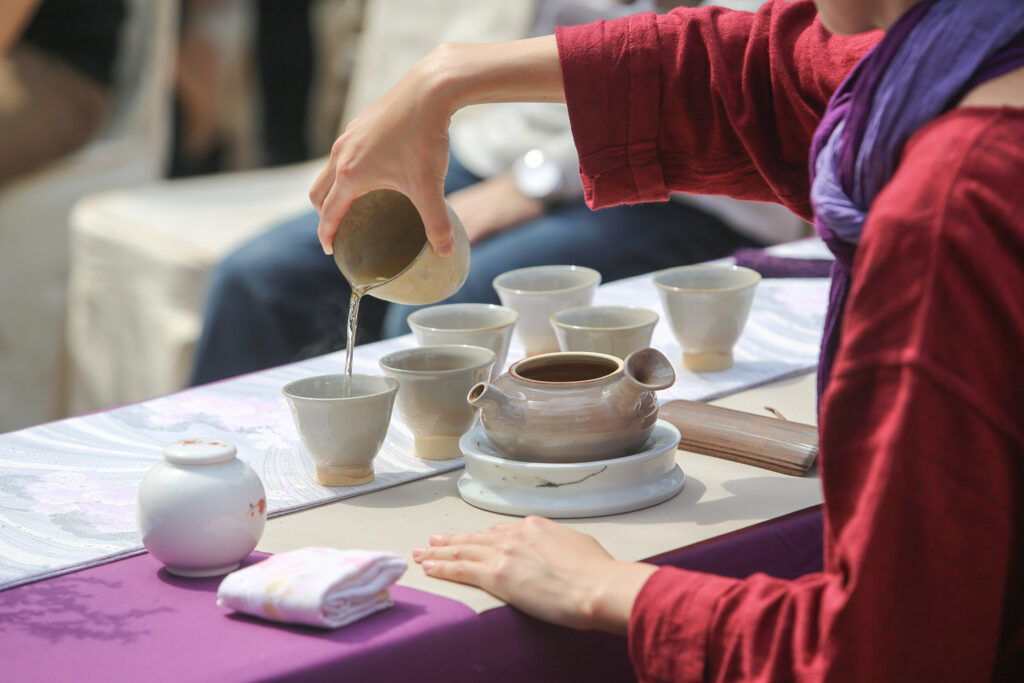
A traditional tea session may involve:
- small teapot
- serving pitcher
- small tasting cups
- multiple infusions
- warming the pot and cups
- smelling the tea
- tasting slowly
The Tea and Beverage Research Station’s own brewing guidance emphasizes using small vessels, multiple brews and progressively adjusting steeping time.
If you are visiting a tea house, simply watch and enjoy.
Ask questions.
That is much more valuable than pretending you already know everything.
Is Bubble Tea Part of Taiwan Tea Culture?
Absolutely.
Just not the same part.
Traditional loose-leaf tea and modern hand-shaken tea drinks exist comfortably beside one another in Taiwan.
You can spend an afternoon drinking Tieguanyin in Maokong and buy pearl milk tea that evening.
Nobody will revoke your tea credentials.
In fact, that contrast is one of the most interesting things about Taiwan.
Tea is simultaneously:
agriculture, tradition, craft, everyday drink and modern pop culture.
If the modern side interests you, our 15 Best Bubble Tea Shops in Taipei guide covers what to drink around the city.
Is Taiwan Worth Visiting Specifically for Tea?
For a serious tea enthusiast?
Definitely.
But we actually think Taiwan works even better for people who like tea but don’t want their entire vacation to be about tea.
You can integrate tea into places you would probably visit anyway:
Taipei → Maokong Tieguanyin
Miaoli → Oriental Beauty
Sun Moon Lake → Ruby Red No.18
Alishan → High-Mountain Oolong
Taitung → Red Oolong
That’s what makes Taiwan unusually easy for tea travel.
You do not necessarily need a separate “tea vacation.”
The tea follows the route.

Taiwan Tea Guide FAQ
What is the most famous tea in Taiwan?
Taiwan is especially famous internationally for oolong tea, including high-mountain oolong, Dong Ding, Tieguanyin and Oriental Beauty.
What tea should a first-time visitor try?
We would start with high-mountain oolong because it is approachable, aromatic and strongly associated with Taiwan. Then try Oriental Beauty and Ruby Red No.18 to understand how different Taiwanese teas can be.
What is the best Taiwan tea?
There is no objective single best tea. For floral tea, try high-mountain oolong or Baozhong. For roasted tea, try Dong Ding or Tieguanyin. For honeyed flavor, try Oriental Beauty. For black tea, try Ruby Red No.18.
Is Alishan tea an oolong?
Most famous Alishan high-mountain tea is oolong, but Alishan describes an origin, not one single cultivar or processing style.
What is Taiwan milk oolong?
“Milk oolong” commonly refers to tea made using Jin Xuan, or TTES No.12, a Taiwanese cultivar capable of displaying a naturally creamy or milk-like aroma.
Where can I drink tea near Taipei?
Maokong is the easiest tea destination within Taipei City. Pinglin and Shiding are excellent choices for visitors who want to go deeper into northern Taiwan tea country.
Where is Oriental Beauty tea from?
Important production regions include Hsinchu, Miaoli, Taoyuan and parts of New Taipei City. It is especially associated with Hakka tea-growing areas in Hsinchu and Miaoli.
What tea is Sun Moon Lake famous for?
Sun Moon Lake and Yuchi are particularly famous for black tea, especially Ruby Red TTES No.18, known for natural cinnamon and mint notes.
What tea is Alishan famous for?
Alishan is famous for high-mountain oolong grown in Chiayi’s mountain tea areas.
Can I visit a Taiwan tea farm?
Yes. Tea farms and tea experiences exist in areas including Pinglin, Miaoli, Nantou, Alishan, Yilan and Taitung. Activities vary by farm and season, so confirm hands-on tea picking in advance.
💁🏻♀️ Which Taiwan Tea Experience Should You Choose?
If your first Taiwan trip is mainly Taipei, start with Maokong.
If tea itself is your main interest but you only have one day, look toward Pinglin.
If you want tea plus Hakka culture and a hands-on countryside experience, consider Miaoli.
If you’re planning a longer Taiwan journey, combine Sun Moon Lake and Alishan.
And if you’re traveling Taiwan’s East Coast, add Luye rather than treating Taitung as simply somewhere to drive through.
The important thing is not trying to collect every famous tea name.
Drink a few slowly.
Compare them.
Ask where they came from.
Look at the mountains or fields around you.
When we plan private Taiwan itineraries, that is usually how we prefer to include tea—not as another attraction that has to be “completed,” but as a reason to stop moving for a while.
Taiwan is very good at giving you reasons to slow down.
Tea might be one of the best.